







Melanoma
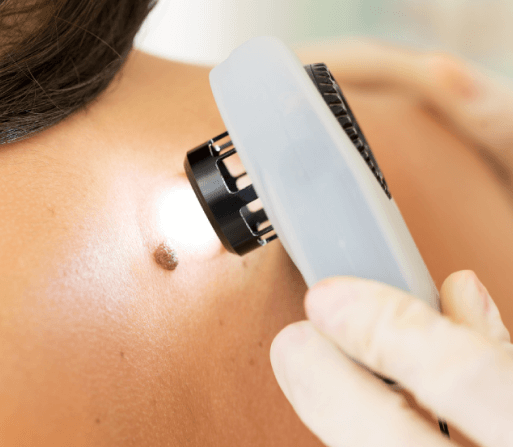
Melanoma, a type of skin cancer that develops from melanocytes, is known for being more aggressive than other skin cancers due to its potential to spread to distant parts of the body, if not detected early. It can develop either as a new lesion, or as an existing mole that undergoes cancerous change.
Dermatologist Led Practice
100,000+ Consultations & Treatments
Key Points
- Melanoma is a significant skin cancer originating from melanocytes.
- It can manifest as a new lesion or changes in an existing mole.
- Notable for its potential to spread to other parts of the body.
- Early detection and treatment are crucial.
- Risk factors include excessive sun exposure, family history of melanoma, and numerous moles.
What is melanoma?
Melanoma is a skin cancer that starts in the melanocytes. It can appear as a changing mole or as a new lesion that changes in color, size, or texture. Melanoma can occur anywhere on the body, not just in sun-exposed areas.
- A type of skin cancer from melanocytes.
- Presents as a changing mole or a new lesion.
- Can occur anywhere on the body.
Who gets melanoma?
Individuals with fair skin, a high number of moles, a history of sunburns, or a family history of melanoma are at an increased risk. However, melanoma can affect people of all skin types. Contact Melbourne skin clinic for dermatology services and treatments tailored to your skin care needs.
- Higher risk in individuals with fair skin and numerous moles.
- Linked to sunburn history and family history.
- Can affect all skin types.
Clinical features
Melanomas typically appear as a new dark spot on the skin or involve changes in an existing mole. The ABCDE rule (Asymmetry, Border irregularity, Color that is not uniform, Diameter greater than 6mm, Evolving size, shape, or color) assists in identifying suspicious features of melanomas.
- Typically appear as new dark spots or changes in moles.
- Rare forms can appear as a red patch or lump.
- The ABCDE rule can help identify some types of melanoma.
- Any new or changing lesion should be evaluated by an experienced doctor.
Diagnosis and differential diagnosis
Diagnosis involves a thorough skin examination and a biopsy of suspicious lesions. Differential diagnosis includes benign moles, seborrheic keratosis, basal cell carcinoma, and squamous cell carcinoma.
- Diagnosed through skin examination and biopsy.
- Differentiated from other skin lesions.
Impact and complications
Melanoma can be serious due to its potential to spread to other body parts, such as the brain, bones, and liver. Early detection and treatment significantly improve the chances of a successful outcome.
- Can spread to other body parts.
- Early detection improves chances of successful treatment.
Breslow thickness, Clark Level and Stages of melanoma
- Assessing the risk of melanoma involves examining many features. This includes its depth and spread through methods such as Breslow thickness, Clark level, and cancer staging, each providing vital information for diagnosis, treatment, and prognosis.
- Breslow thickness measures the depth of melanoma in the skin and categorises melanomas as thin (less than 1.0 mm), intermediate (1.0 to 4.0 mm), or thick (more than 4.0 mm), corresponding to their risk.
- The Clark Level categorises melanoma into five stages based on the depth of invasion into the skin's layers, ranging from Level I (confined to the outermost layer) to Level V (spread into the subcutaneous fat), influencing treatment decisions and prognosis.
- Other clinical & histological features of melanoma can stratify risk of future spread.
- Melanomas can also be 'staged' from Stage 0 to Stage IV. Higher stages indicate more advanced cancer with Stage 0 (in situ) where melanoma cells are confined to the epidermis, to Stage IV where melanoma has spread to distant sites.
Treatment options for melanoma
Wide local excision (a bigger safety margin cut) is the primary treatment for early-stage melanomas, where the width of excision depends on the Breslow thickness, with wider margins for thicker melanomas. Sentinel lymph node biopsy is performed to check for the spread of cancer in cases of intermediate or thick melanomas. Immunotherapy stimulates the body’s immune system to attack cancer cells, while targeted therapy is used for melanomas with specific genetic mutations. Chemotherapy and radiation therapy are also used in advanced or metastatic melanoma. Early-stage melanoma generally has a high cure rate with the need of regular skin checks, whereas advanced melanoma requires ongoing treatment and close monitoring.
- Treatment varies based on the stage and Breslow thickness of the melanoma.
- Wide local excision is the main treatment for early stages.
- Advanced stages may need additional therapies like immunotherapy and targeted therapy.
- Early-stage melanoma generally has a high cure rate.
- Continuous treatment and monitoring are necessary for advanced melanoma.
See what our patients have to say
Blog Posts

Beyond the Dark Spot
The lesser-known faces of melanoma In the discourse on skin cancer, melanoma is often depicted by its most recognisable form; a dark, ugly-looking mole. However,

The Impact of Hyperhidrosis
Life’s worries Sweat is something that most people hardly think about. It’s just something that happens when it’s hot, when your working out, or sometimes

Why am I sweating so much?
The 101 on hyperhidrosis If you are self-conscious about how much you sweat, you could be suffering from a condition called hyperhidrosis. Many people


